
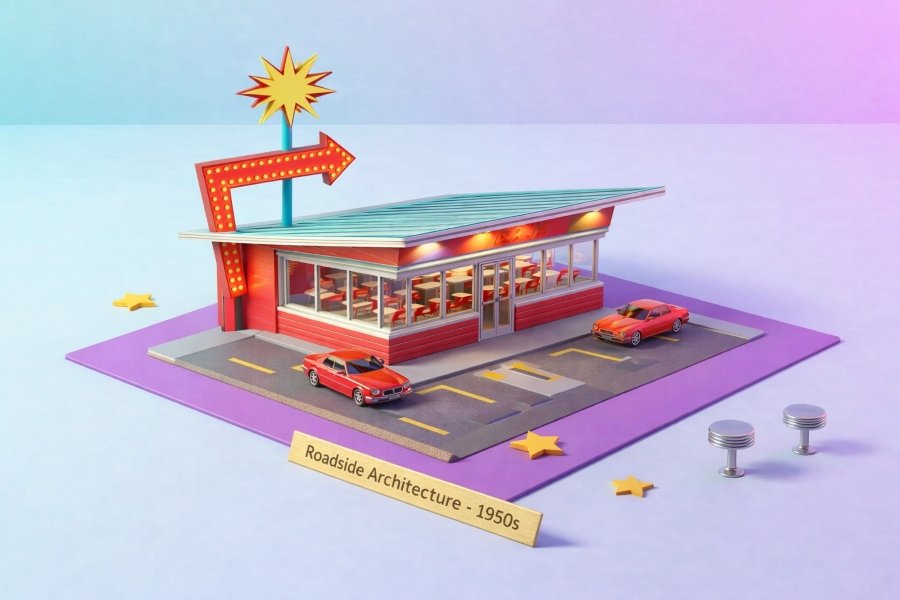
What we now recognize as one of the most famous logos in the world didn’t start in a graphic designer’s sketchbook. It began as a bold, structural experiment in 1950s roadside architecture designed to catch the eye of a fast-moving, car-obsessed public.
1. The Architectural Beacon (1952)
When Richard and Maurice McDonald were looking to upgrade their original San Bernardino stand, they wanted a building that acted as its own billboard. They hired architect Stanley Clark Meston to bring their vision to life.
The result was a “Googie” style masterpiece: a walk-up stand featuring two massive, 25-foot neon-yellow sheet metal arches. These arches weren’t just decorative; they were physically built into the sides of the structure, glowing brilliantly to signal drivers from down the highway that a meal was waiting.
2. The Birth of the “M” (1962)
For the first decade, the arches were strictly functional architecture. It wasn’t until Jim Schindler, the company’s head of engineering and design, looked at the building from a specific angle that the logo was born.
In 1962, Schindler took the two separate structural arches and joined them at the base in a sketch. He added a “cross-dash” representing the roofline of the building, creating the first iteration of the “M” logo. This transformed a physical building feature into a portable brand symbol that could be printed on bags, cups, and signs.
3. The Arches That Almost Vanished
In the 1960s, as the brand began to modernize, there was a serious proposal to scrap the arches entirely and move toward a more “contemporary” look.
However, design consultant and psychologist Louis Cheskin famously argued against the change. He believed the arches had a profound “Freudian” appeal, suggesting they subconsciously reminded customers of a pair of maternal, nourishing breasts. Whether you subscribe to that psychological theory or not, the argument worked—the arches stayed, and the rest is history.
4. Global Exceptions
Today, while the golden “M” is standard, there are a few rare places where the arches adapt to local regulations, mirroring the way the menu adapts to local tastes:
-
The Turquoise Arches: In Sedona, Arizona, the arches are turquoise to blend in with the surrounding natural desert landscape.
-
The White Arches: In Paris, France, on the Champs-Élysées, you’ll find white arches to comply with the district’s strict aesthetic guidelines.
-
The Single Arch: In some older locations, you can still find the rare “Single Arch” sign, a relic of the era before the double-arch “M” became the global standard.