The Great Meatless Showdown: The Rise of the Filet-O-Fish and the Fall of the Hula Burger
In the early 1960s, a franchise owner in Cincinnati named Lou Groen noticed a problem. His restaurant was located in a predominantly Catholic neighborhood, and every Friday during Lent, his sales would plummet as customers abstained from eating meat. To save his business, Groen developed a breaded whitefish sandwich.
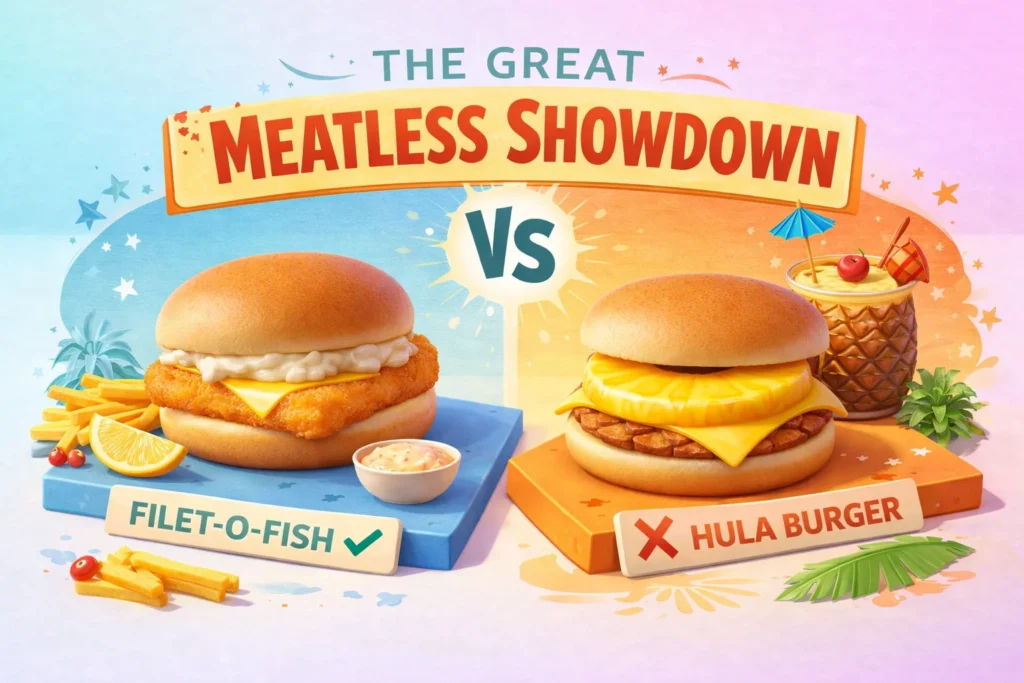
However, Ray Kroc, the man behind the brand’s global expansion, wasn’t convinced. He had his own idea for a meatless alternative: the Hula Burger.
The Hula Burger: A Tropical Experiment
Ray Kroc’s brainchild was simple—perhaps too simple. The Hula Burger consisted of a cold, grilled ring of pineapple and a slice of cheese on a toasted bun. Kroc was convinced that the sweetness of the pineapple would be a hit with customers looking for a meat-free Friday meal.
The 1962 Friday Face-Off
To settle the debate, Kroc and Groen agreed to a “Friday Face-Off” in 1962. They selected a specific Friday to sell both items and see which one performed better.
The results weren’t even close. While the Hula Burger sold a dismal 6 sandwiches, the Filet-O-Fish sold over 350. The pineapple burger was immediately discontinued and relegated to the archives of fast-food failures, while the Filet-O-Fish was fast-tracked for a national rollout by 1965.
Why the Pineapple Failed
While the Hula Burger seems bizarre today, it represented an early attempt at “menu adaptation.” Its failure taught the company a vital lesson: customers don’t just want a placeholder for meat; they want a satisfying, savory alternative. The Filet-O-Fish worked because it felt like a complete meal, whereas the Hula Burger felt like a side dish served on a bun.
A Lasting Legacy
Today, the Filet-O-Fish remains one of the few items on the menu that has stayed largely unchanged for over 60 years. It also paved the way for the sophisticated regional adaptations we see today—from the McAloo Tikki in India to the McSpicy in Asia. While the Hula Burger is long gone, it remains a favorite piece of trivia for food historians—a reminder that even the most successful brands in the world have had their fair share of “tropical” missteps.