If you’ve ever stood at a McDonald’s counter trying to do macro math in your head, you know how quickly it falls apart. Is the Quarter Pounder going to blow your protein target? Will the fries push you over your carb ceiling? Can you fit a second item in without wrecking your calorie goal for the day?
That’s exactly the problem the McFacts Meal Planner was built to solve.
What Is the McFacts Meal Planner?
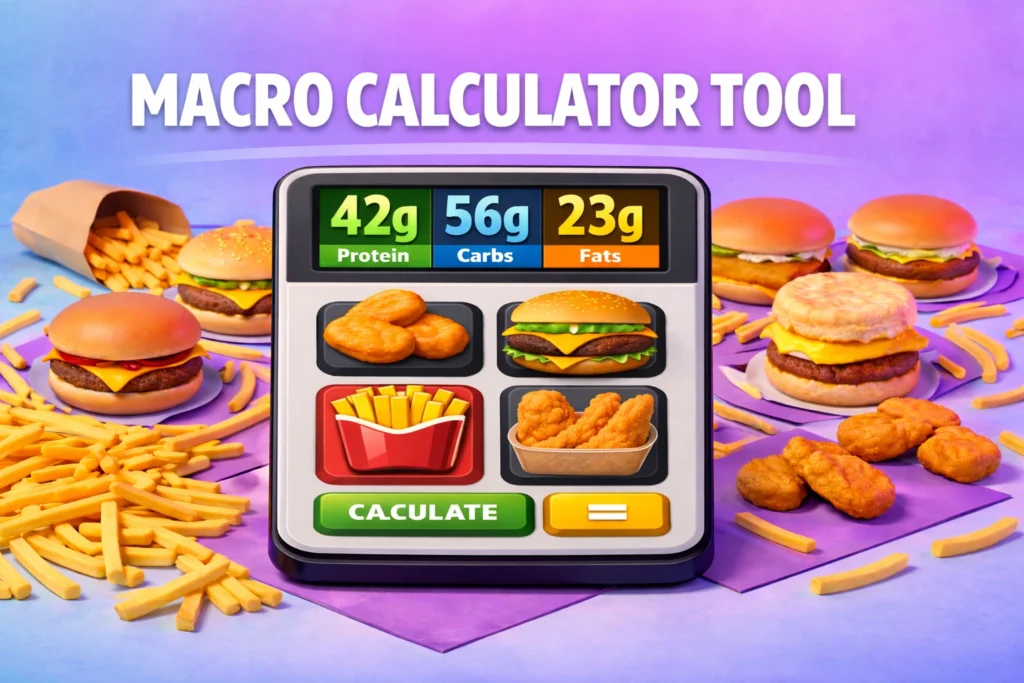
The McFacts Meal Planner is a free tool — right here on McFacts.com — that helps you build a McDonald’s meal around your personal nutrition targets. You tell it your calorie goal, an optional minimum protein target, and an optional maximum carb ceiling. It then searches through the McDonald’s USA menu and finds the best 1–3 item combinations that hit your numbers.
Every combo gets a match score out of 100%, so you can see at a glance how close each option comes to your goals. The best match rises to the top, and two runner-up options give you flexibility depending on what you’re in the mood for.
It’s not magic — it’s just the math done for you, fast.
Why Does This Matter?
McDonald’s gets a bad rap in fitness circles, but the reality is more nuanced. For a lot of people — athletes, shift workers, travelers, busy parents — McDonald’s is a practical option, not a guilty pleasure. The question isn’t whether you should eat there. The question is: if you are eating there, how do you make it work for your goals?
Tracking macros manually at a fast food counter is genuinely hard. The numbers aren’t printed on the menu board. Mental math under pressure leads to bad estimates. And most generic nutrition apps don’t let you search by combination — they track what you’ve already eaten, they don’t help you plan what to order.
The McFacts Meal Planner flips that around. You start with your targets and work backward to a real, orderable meal.
Why No Drinks?
This one comes up, and the answer is straightforward: drinks are too variable to be useful in a macro planner focused on food.
A small Coke and a large Coke are the same item with wildly different calorie counts. Diet options have no calories at all. Shakes and McCafé drinks range from a light coffee to something approaching a full meal in calorie terms — and they vary enormously by size, customization, and seasonal availability.
More importantly, most people who are tracking macros are already handling their drinks separately. Water, black coffee, and diet sodas are effectively zero-calorie choices that don’t need to be planned around. And anyone drinking a high-calorie shake already knows it — they’re not looking for the planner to factor it in.
Keeping drinks out keeps the tool focused. If we included them, every combo result would be cluttered with drink size variations that add noise without adding value.
Why No Desserts?
Same logic, taken a step further. Desserts at McDonald’s — McFlurries, apple pies, sundaes — are add-ons, not meals. They’re calorie-dense, low in protein, and almost never the reason someone is at McDonald’s trying to hit a macro target.
A fitness-focused user planning a 700-calorie, 40g protein meal isn’t building that meal around a McFlurry. And a casual user who wants to add a sundae to their order doesn’t need a planner to tell them it exists.
Including desserts in the combo search would also skew the algorithm. A high-calorie dessert item could appear in results as a “match” simply because it fills calorie space — which isn’t helpful to anyone.
Why No Sauces and Condiments?
Sauces are a modifier, not a main. A packet of BBQ sauce or a side of ranch adds calories, yes — but in the context of a 500–900 calorie meal, we’re talking about 30–50 calories that sit below the margin of error for most people’s tracking anyway.
More practically: sauces don’t change what you order, they change how you eat what you ordered. The planner is designed to help you decide what to order at the counter, not to audit every condiment that ends up on your tray.
A future version of the tool may include an optional modifier system — things like “no bun” or “extra patty” — that affect macros more meaningfully. Sauces are a much smaller lever and are best left to personal discretion.
What’s Actually In the Planner?
The current version covers 48 items across five categories:
- Burgers — from the Hamburger all the way up to the Double Quarter Pounder with Cheese
- Chicken & Fish — McChicken, McCrispy, Filet-O-Fish, McNuggets in three sizes, and more
- Snack Wraps — the recently returned Snack Wrap lineup
- Fries & Sides — three fry sizes and the Hash Brown
- Breakfast — McMuffins, McGriddles, Biscuits, Hotcakes, Burritos, and the Big Breakfast
All nutrition data is based on publicly available McDonald’s USA nutritional information.
Try It
The McFacts Meal Planner is live and free to use. No sign-up, no app download, no ads getting in the way. Just your targets and the menu.