
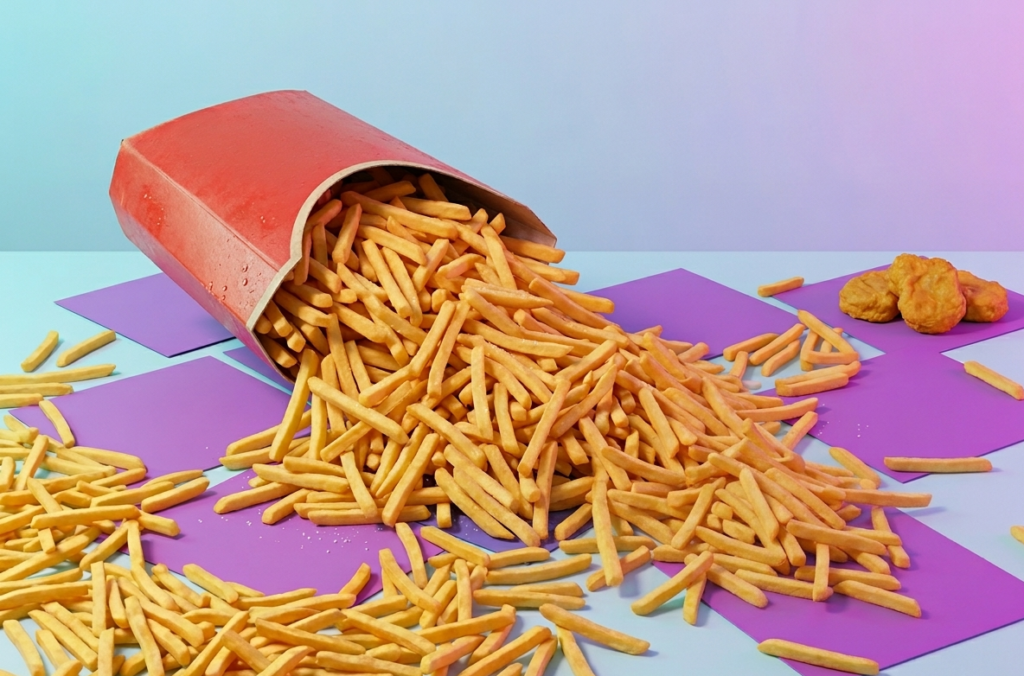
The secret to the world’s most recognizable side dish isn’t just luck—it’s a masterclass in food engineering. To achieve that legendary “gold standard,” every single fry undergoes a rigorous journey from the soil to the fryer to ensure the perfect crisp-to-fluff ratio every time.
The Science of the Spud
It all starts with the variety. You won’t find just any potato in the bin; the process typically relies on high-starch, low-moisture varieties like the Russet Burbank or the Shepody. These specific potatoes are chosen for their elongated shape—yielding those signature long strips—and their ability to develop a floury, mashed-potato-like center when cooked.
The Factory Foundation
Before a fry even reaches a restaurant, it undergoes a multi-step transformation:
- Precision Cutting: The potatoes are shot through a series of blades at high speeds to ensure uniform thickness.
- The Blanching Bath: This step strips away natural sugars that might cause the fries to turn too dark or “patchy” when fried.
- The Sugar Coat: A thin layer of dextrose (a natural sugar) is often applied to ensure a perfectly even, golden-brown hue across the entire batch.
- Sodium Acid Pyrophosphate: This prevents the potatoes from turning gray or oxidizing after they are cut.
The Double-Fry Method
The true magic lies in the par-frying process. At the processing plant, the fries are partially cooked and then immediately flash-frozen. This “shocks” the starch on the surface, creating a microscopic crust.
When they finally arrive at the restaurant, they are fried a second time in a high-quality oil blend. This final hit of heat completes the transition: the frozen moisture inside steams the center to a fluffy perfection, while the exterior dehydrates into a distinct, salty crunch.
The Result
This obsession with consistency means that whether you are in Ottawa, Tokyo, or Rome, the experience remains identical. It’s a 3,000-mile supply chain designed to deliver a specific, nostalgic crunch that has remained unchanged for decades.